

SHOWING ITEMS 16-23 of 23
-

OBSOLETE - Millipore Synergy Water Purification System
Your Price: $0.00 -

OBSOLETE -Millipore Q-POD Element
Your Price: $0.00 -

OBSOLETE -Millipore Milli-Q Direct 16 Water Purification System
Your Price: $0.00 -

OBSOLETE - Millipore Milli-Q Direct 8 Water Purification System
Your Price: $0.00 -

OBSOLETE - Millipore Milli-Q Integral 15 Water Purification System
Your Price: $0.00 -

OBSOLETE - Millipore Milli-Q Integral 10 Water Purification System
Your Price: $0.00 -

OBSOLETE - Millipore Milli-Q Integral 5 Water Purification System
Your Price: $0.00 -

OBSOLETE - Millipore Milli-Q Integral 3 Water Purification System
Your Price: $0.00
How a Milli-Q Water System Delivers Ultra-Pure Results
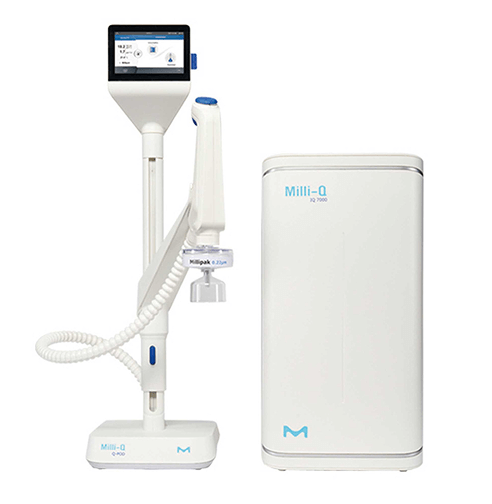
A Milli-Q water system uses a multi-stage process to reach the highest purity standard available for laboratory water. It typically combines reverse osmosis, electrodeionization, UV oxidation, and final-stage filtration to remove even the most minuscule impurities.
Our team calibrates each component to produce Type 1 ultra-pure water with resistivity near 18.2 MΩ cm and TOC levels below 10 ppb.
The system maintains purity throughout distribution by controlling exposure to air and surface leaching. This closed-loop precision ensures that every drop meets the requirements of high-sensitivity lab work.
Key Advantages of Using a Type 1 Ultrapure Water System in Your Lab
Using a Type 1 ultra-pure water system gives more than just clean water: it creates a controlled baseline for every procedure that depends on chemical precision. These systems reduce the risk of error and improve consistency across sensitive workflows.
Some key advantages of utilizing this water system include the following, and so much more:
- Reliable purity at the point of use, preventing contamination right before application
- Stable resistivity and low TOC levels, critical for trace analysis and molecular biology
- Compact, modular system designs that fit into existing lab layouts without disruption
- Reduced reliance on bottled water, lowering storage needs and contamination risk
- Continuous monitoring features, providing real-time data to support audit trails and compliance
Choosing a Milli-Q water system supports both operational efficiency and data integrity, especially in environments where results are under constant scrutiny.
Milli-Q Water System Use in Research, Production, and Compliance-Driven Environments
A Milli-Q system isn't limited to academic labs. Instead, it's ideal for any setting where water purity directly impacts process control, product quality, or regulatory approval.
In pharmaceutical production, these systems support cleanroom protocols and validation requirements by supplying consistent Type 1 ultra-pure water on demand.
Research institutions rely on them to feed instrumentation such as HPLC, ICP-MS, and TOC analyzers, where trace contaminants can skew results. In biotech and life sciences, Milli-Q water systems help maintain sterile conditions for cell culture and DNA sequencing.
FAQs About Type 1 Water Purification Systems
How is Type 1 ultrapure water different from RO or distilled water?
Type 1 ultrapure water has far lower levels of ions, organics, and particulates compared to reverse osmosis or distilled water. RO and distillation remove many contaminants, but only a Milli Q water system reaches the resistivity and TOC thresholds required for analytical and molecular-grade work.
Can a Milli Q water system support multiple lab stations at once?
Yes, many MilliQ systems are designed for multi-point distribution, often through pressurized loops or dedicated dispensing points. This allows multiple users to access consistent Type 1 laboratory water without fluctuations in quality or flow rate.
How often should I replace filters and cartridges?
Replacement frequency depends on system usage, inlet water quality, and monitoring data. Most Milli-Q water systems include alerts or resistivity readouts to indicate when prefilters, UV lamps, or polishing cartridges require attention.
What lab applications require Type 1 laboratory water?
Type 1 water is essential for high-precision tasks such as cell culture, DNA/RNA extraction, trace metal analysis, and the preparation of standards for chromatographic instruments. These processes rely on water that won't introduce detectable interference at the molecular level.
Get Expert Help Choosing the Right Milli-Q System for Your Facility
Select a Milli-Q water system that meets the exact standards your lab work demands. Contact our team for expert support and product recommendations tailored to your application, compliance needs, and workflow.
We're here to help you build purity into every step. Get started today.
Contact Us Now to Get Started